Żadne treści nie pasują do wyszukiwanego hasła.
Wszystko

You have successfully logged out.


Zanieczyszczenie cząstkami stałymi w pediatrii i neonatologii
Zanieczyszczenie cząstkami stałymi oznacza niezamierzoną obecność obcych, przemieszczających się i nierozpuszczonych cząstek w roztworach podawanych pozajelitowo.3, 4
Głównym źródłem zanieczyszczeń cząstkami stałymi są produkty lecznicze znajdujące się w różnych typach opakowań (np. fiolkach, ampułkach, pojemnikach fabrycznie napełnionych oraz gotowych roztworach do infuzji). Wiele zanieczyszczeń pochodzi z materiałów takich jak szkło, tworzywa sztuczne, guma i/lub z nierozpuszczonych substancji stałych. Cząstki te mogą mieć różną wielkość i stanowić poważne zagrożenie dla zdrowia pacjentów neonatologicznych i pediatrycznych.
Zgodnie z obowiązującymi przepisami prawa, oświadczam, że jestem osobą wykonującą zawód medyczny lub prowadzącym obrót wyrobami medycznymi. Mam świadomość, że treści zamieszczane na niniejszej stronie mogą zawierać między innymi wiadomości na temat wyrobów niebezpiecznych dla zdrowia i bezpieczeństwa pacjentów.
Potwierdź Jestem profesjonalistą z branży medycznej. Anuluj Nie jestem profesjonalistą z branży medycznej.
Czy wiesz, że szacuje się, że 1 mln Mio? cząstki dziennie podawane są na oddział intensywnej terapii? 1,2
Cząstki stałe podawane w infuzji są uznawane za dodatkowy czynnik ryzyka u pacjentów oddziałów intensywnej terapii.⁵ Zwiększają ryzyko zakrzepicy, zaburzeń mikrokrążenia oraz modulacji odpowiedzi immunologicznej.6
W przypadku dzieci i noworodków ryzyko związane z zanieczyszczeniem cząstkami stałymi jest szczególnie wysokie.
W licznych badaniach opisano konsekwencje tego zjawiska u ciężko chorych dzieci. Podawanie cząstek stałych u pacjentów pediatrycznych może:
Noworodki hospitalizowane na oddziałach intensywnej terapii są szczególnie narażone ze względu na swoją fizjologię oraz fakt, że często jednocześnie podaje się im wiele leków w postaci iniekcji. Nawet bardzo małe objętości płynów mogą prowadzić do niepełnego rozpuszczenia leku i zwiększać ryzyko niezgodności farmaceutycznej.11
U noworodków podawanie cząstek stałych może zwiększać ryzyko powikłań, takich jak stan zapalny, sepsa czy martwicze zapalenie jelit.12
W porównaniu z dorosłymi, podanie cząstek stałych pacjentom pediatrycznym wywiera bardziej nasilony efekt. Jedną z przyczyn mogą być różnice w charakterystyce układu sercowo-naczyniowego. Noworodki mają mniejszą liczbę oraz średnicę naczyń krwionośnych w obrębie kapilar płucnych.13, 14
Aby zmniejszyć ryzyko zanieczyszczenia cząstkami stałymi, należy zwrócić uwagę na następujące aspekty:
Brytyjska Grupa ds. Żywienia Farmaceutycznego (BPNG) zaleca stosowanie odpowiednich filtrów podczas podawania żywienia pozajelitowego pacjentom z obniżoną odpornością, takim jak dzieci i noworodki, w celu uniknięcia zanieczyszczenia nierozpuszczalnymi cząstkami.15
Filtry liniowe stosowane w infuzji dożylnej są rekomendowane jako sposób ograniczenia liczby cząstek podawanych przez cewniki centralne oraz zapobiegania przedostawaniu się bakterii i endotoksyn16
Zastosowanie filtracji liniowej może zmniejszyć częstość występowania ciężkich powikłań związanych z obecnością cząstek stałych u krytycznie chorych pacjentów pediatrycznych i noworodków, takich jak: SIRS (zespół ogólnoustrojowej reakcji zapalnej), sepsa, niewydolność krążenia, ARDS (ostry zespół niewydolności oddechowej), zakrzepica, ostra niewydolność nerek oraz ostra niewydolność wątroby.
Ogólny wskaźnik występowania tych poważnych powikłań można zmniejszyć o około 10% (z 40,9% do 30,9%) przy zastosowaniu filtrów dożylnych.17
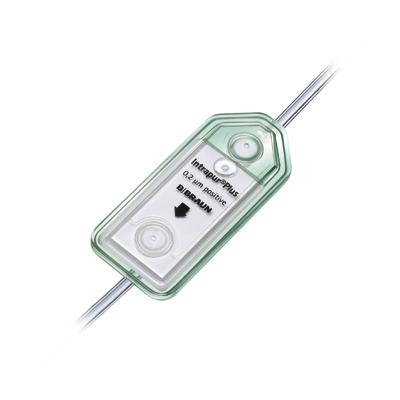
*Dotyczy filtrów Intrapur® z naszego portfolio
Standaryzacja procesów może zapobiegać ciężkim powikłaniom w intensywnej terapii oraz zwiększać bezpieczeństwo pacjentów. Włączenie stosowania odpowiednich filtrów do rutynowej praktyki na oddziałach intensywnej terapii pediatrycznej i neonatologicznej pozwala zminimalizować ryzyko zanieczyszczenia cząstkami stałymi u najmłodszych pacjentów.
Oprócz zmniejszenia chorobowości w populacji pediatrycznej, ograniczenie liczby cząstek prowadzi również do skrócenia czasu hospitalizacji oraz wentylacji mechanicznej.17 W rezultacie mali pacjenci mogą szybciej opuścić oddział intensywnej terapii i wrócić do domu i do swoich rodzin, aby po prostu rosnąć i cieszyć się dzieciństwem.
Zostanie przekazane odpowiedniej osobie kontaktowej, która skontaktuje się z Tobą tak szybko, jak to możliwe.
1. Mehrkens HH, Klaus E, Schmitz JE. Possibilities of material contamination due to additional injections. Klin Anasthesiol Intensivther. 1977;14:106-13.
2. Walpot H, Franke RP, Burchard WG, Agternkamp C, Müller FG, Mittermayer C, Kalff G. Particulate contamination of infusion solutions and drug additives within the scope of long-term intensive therapy. 1. Energy dispersion electron images in the scanning electron microscope-REM/EDC. Anasthesist. 1989;38(10):544-8.
3. Werner BP, Winter G. (2015) Particle contamination of parenteralia and in-line filtration of proteinaceous drugs. Int J Pharm;496(2):250-67
4. Doessegger L, Mahler HC, Szczesny P, Rockstroh H, Kallmeyer G, Langenkamp A, Herrmann J, Famulare J. (2012) The potential clinical relevance of visible particles in parenteral drugs. J Pharm Sci; 101(8): 2635-44
5. Jack T. Micro Particles Contamination. Innocent Bystander or Real Threat? 2012 (Presentation: „_Micro Particles Contamination_Jack_MHH_2012“).
6. Boehne M, Jack T, Köditz H, Seidemann K, Schmidt F, Abura M, Bertram H, Sasse M. In-line filtration minimizes organ dysfunction: new aspects from a prospective, randomized, controlled trial. BMC Pediatr. 2013;13:21.
7. Puntis JW, Wilkins KM, Ball PA, Rushton DI, Booth IW. Hazards of parenteral treatment: do particles count? Arch Dis Child 1992 Dec;67(12):1475–7.
8. Breaux CW, Duke D, Georgeson KE, Mestre JR. Calcium phosphate crystal occlusion of central venous catheters used for total parenteral nutrition in infants and children: prevention and treatment. J Pediatr Surg 1987 Sep;22(9):829–32.
9. Bradley JS, Wassel RT, Lee L, Nambiar S. Intravenous ceftriaxone and calcium in the neonate: assessing the risk for cardiopulmonary adverse events. Pediatrics 2009 Apr;123(4):e609–13.
10. Monte SV, Prescott WA, Johnson KK, Kuhman L, Paladino JA. Safety of ceftriaxone sodium at extremes of age. Expert Opin Drug Saf 2008 Sep;7(5):515–23.
11. Perez M, Maiguy-Foinard A, Barthélémy C, Décaudin B, Odou P. Particulate Matter in Injectable Drugs: Evaluation of Risks to Patients. Pharmaceutical Technology in Hospital Pharmacy 2016;1(2):91-103.
12. Van Lingen RA, Baerts W, Marquering ACM, Rujis GJHM. The use of in-line filtration in sick newborn infants. Acta paediatrica 2004; 93:1-5.
13. Heyman S. Toxicity and safety factors associated with lung perfusion studies with radiolabeled particles. J Nucl Med Off Publ Soc Nucl Med 1979 Oct;20(10):1098–9.
14. Lofthus RM, Srebnik HH. The physical dimensions of the human neonatal cardiovascular system. J Biomech Eng 1987 Nov;109(4):336–9.
15. Bethune K Allwood M, Grainger C, Wormleighton C; British Pharmaceutical Nutrition Group Working Party. (2001) Use of filters during the preparation and administration of parenteral nutrition: position paper and guidelines prepared by a British pharmaceutical nutrition group working party. Nutrition;17(5):403-8.
16. Virlouvet AL, Pansiot J, Toumazi A et al. In-line filtration in very preterm neonates: a randomized controlled trial. Sci Rep 2020; 10(5003).
17. Jack T, Boehne M, Brent BE, Hoy L, Köditz H, Wessel A, Sasse M. In-line filtration reduces severe complications and length of stay on pediatric intensive care unit: a prospective, randomized, controlled trial. Intensive Care Med. 2012; 38:1008–1016.
Spersonalizowane konto sprawia, że korzystanie z Internetu jest łatwiejsze, wygodniejsze i bezpieczniejsze.